





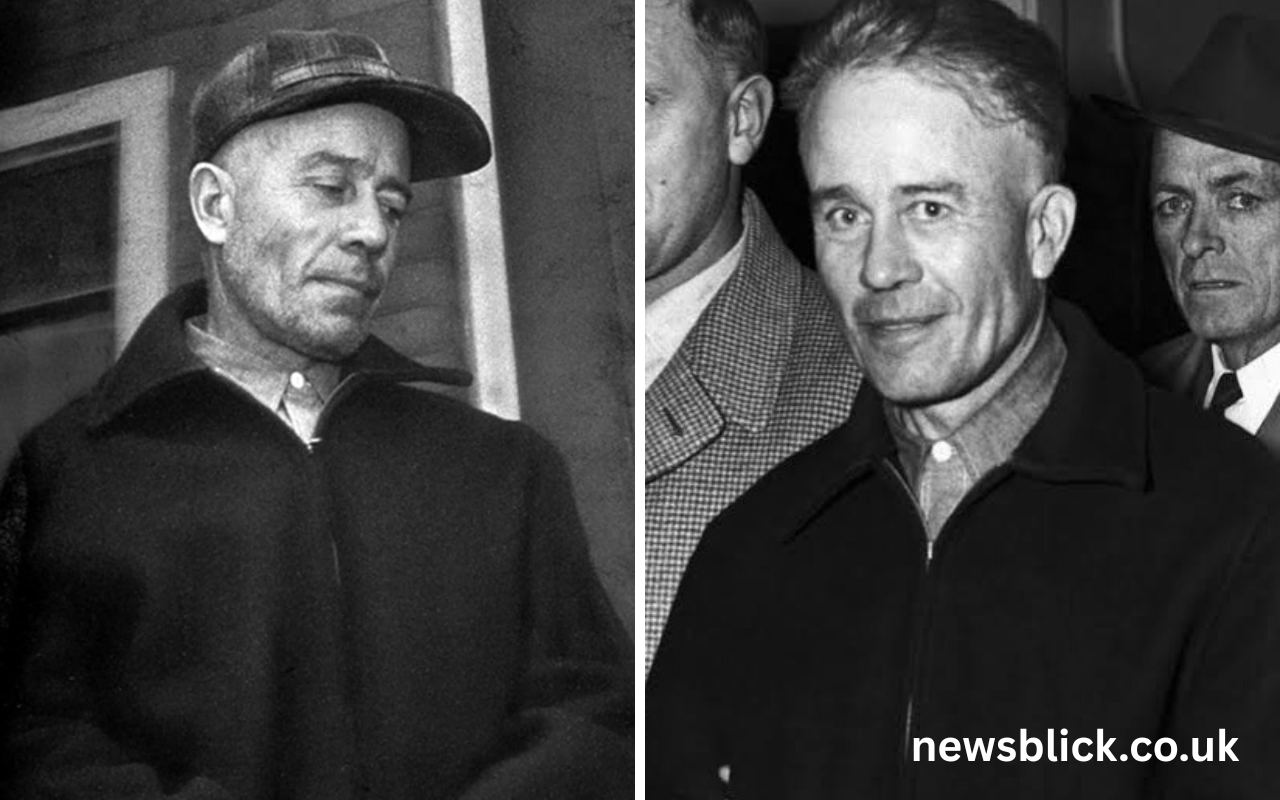
George Philip Gein: The Forgotten Father Behind a Dark Legacy
The Shadowed Origins of George Philip Gein
George Philip Gein entered a world that seemed determined to break him from the very beginning. Born on August 4, 1873, in Bergen, Vernon County, Wisconsin, he came into a rural America that offered little comfort or opportunity for the poor and the orphaned. Historical records suggest that George lost both of his parents at a relatively young age, a traumatic start that left him without guidance or a stable family structure. This early exposure to loss and instability likely planted the first seeds of the alcoholism and emotional detachment that would later define his relationships with his own wife and children. Growing up in the hardscrabble landscape of late nineteenth century Wisconsin meant that George had to fend for himself from childhood, developing survival instincts but never learning the softer skills of affection, patience, or consistent parenting.
The lack of a formal support system meant that George drifted through his young adult years with few prospects and even fewer emotional resources. He worked whatever jobs he could find, moving between towns and trying to establish some semblance of a normal life. When he met Augusta Wilhelmine Lehrke, a woman five years his junior with strict religious convictions and a powerful will, George likely saw a chance for stability and structure. What he did not realize was that Augusta’s domineering nature would eventually crush any remaining self esteem he possessed. Their marriage in 1900 was not a union of equals but rather a partnership where Augusta would steadily assume control, leaving George to retreat into the bottle and into silence. The foundations of the Gein family tragedy were laid not in the infamous farmhouse in Plainfield but in the unhappy early years of this mismatched couple.
Understanding George’s childhood is essential for anyone trying to piece together the full puzzle of the Gein family dysfunction. While never an excuse for his later abusive behavior, the fact that George grew up without parents helps explain why he was so ill equipped to be a father himself. He had no model of gentle paternal care to draw upon, no memory of a father’s loving correction or patient teaching. Instead, George only knew the harsh realities of rural poverty, early loss, and the numbing escape of alcohol. This multigenerational cycle of trauma and neglect is a familiar pattern in criminal psychology, and George Philip Gein stands as a textbook example of how unresolved pain can transform a person into a source of pain for others. His story is not one of innate evil but of profound failure, a failure born from his own lack of nurturing.
A Marriage Built on Contempt and Control
The union between George Philip Gein and Augusta Lehrke was doomed from the very start, not because of any single dramatic event but because of a fundamental incompatibility in their personalities and expectations. Augusta was a fiercely religious woman who believed wholeheartedly in the sinfulness of alcohol, the corruption of the secular world, and the absolute authority of a wife over her household. George, by contrast, was a quiet man who lacked ambition and found his only solace in drinking. Within the first few years of their marriage, Augusta had already begun to openly criticize her husband’s shortcomings, comparing him unfavorably to other men in their community and making no secret of her disappointment. This constant belittling created an atmosphere of resentment that never truly dissipated, poisoning every interaction between the two parents.
Augusta’s control over the household extended to nearly every aspect of daily life, including finances, child rearing, and even social interactions with neighbors. George was gradually pushed to the margins of his own family, allowed to exist but never to lead or make important decisions. When the couple’s first son, Henry George Gein, was born in 1901, Augusta took charge of his upbringing completely, leaving George with little to do but provide manual labor when he was sober enough to perform it. The birth of Edward Theodore Gein in 1906 only intensified Augusta’s possessiveness, as she poured all of her attention and rigid moral teachings into her younger son. George found himself increasingly isolated within his own home, a man whose wife looked at him with disgust and whose children learned to fear rather than love him.
The marriage deteriorated further when the family relocated to the remote farm outside Plainfield, Wisconsin, around 1914. Augusta orchestrated this move specifically to insulate her sons from what she saw as the corrupting influences of town life, including bars, loose women, and secular schools. For George, the move was a form of exile, cutting him off from whatever limited social connections he had maintained in La Crosse. On the isolated farm, Augusta’s control became absolute, and George’s drinking worsened as he had nothing to do but brood over his failures. The farmhouse that would later become a site of unspeakable horror was, in George’s lifetime, simply a prison where a broken man slowly drank himself to death while his wife taught their sons that their father was a worthless sinner destined for hell. This toxic dynamic, where one parent openly despises the other, is devastating for any child, and it left deep scars on both Henry and Ed Gein.
The Alcoholic Father Who Used Violence as a Language
George Philip Gein was not merely a passive alcoholic who sat quietly while his wife ran the household. Historical accounts and Ed Gein’s own later confessions make it clear that George was physically abusive toward his sons, often violently so. When Ed described his father beating him so hard that his ears would ring, he was describing a pattern of punishment that had little to do with discipline and everything to do with rage. George’s alcoholism meant that his moods were unpredictable, and his sons never knew when a minor mistake or even an innocent question would trigger a beating. This constant threat of physical violence created an atmosphere of terror in the Gein household, where both Henry and Ed learned to walk on eggshells and to avoid their father whenever possible.
The violence George inflicted was not calculated or strategic but rather the explosive outbursts of a man drowning in self hatred and alcohol. Unlike Augusta, whose punishments were cold and ideological, George’s abuse was hot, sloppy, and often followed by periods of weepy remorse or deepening silence. This inconsistency made him even more frightening to his young sons, because there was no reliable pattern to predict when he would explode. Ed later described his father as a man with no control over his own emotions, someone who could shift from silence to screaming in an instant. For a sensitive and socially awkward child like Ed, who already struggled with a speech impediment and bullying at school, coming home to a violent father was an additional trauma that further convinced him the outside world was a dangerous and hostile place.
Interestingly, George’s violence toward his sons did not extend to his wife. Augusta remained physically untouched by her husband’s rages, perhaps because she was the one person in the household George truly feared. Augusta’s fierce personality and moral superiority intimidated George, and he directed his physical aggression only at the children, who were smaller and more vulnerable. This selective violence is a common pattern in dysfunctional families, where the weaker members absorb the rage that cannot be safely expressed toward the dominant partner. For Ed and Henry, watching their father cower before their mother while beating them violently taught a terrible lesson about power and weakness. They learned that masculinity could be both aggressive and impotent at the same time, a confusing contradiction that would haunt Ed throughout his life. The fists of George Philip Gein left marks that went far deeper than bruises, shaping his sons’ understanding of love, fear, and family.
The Isolation of the Plainfield Farm and Its Psychological Toll
The decision to purchase the one hundred fifty five acre farm outside Plainfield was Augusta’s, driven by her desire to create a fortress where her sons would be safe from the temptations of the modern world. For George, however, the farm became a place of profound loneliness and degradation. The property was remote, located miles from the nearest neighbors, with no telephone and limited access to supplies. George, who had never been a particularly skilled farmer, found himself expected to perform labor he was neither physically nor emotionally equipped to handle. His drinking increased as the isolation deepened, and neighbors later recalled seeing him stumble around the property in a drunken haze, muttering to himself or shouting at his sons. The farm, intended by Augusta as a sanctuary, instead became a pressure cooker where every flaw in the family was magnified by the lack of outside contact.
For the Gein children, the isolation had catastrophic effects on their social and emotional development. Henry and Ed were forbidden from bringing friends home, and Augusta actively discouraged them from forming attachments at school. When Henry once attempted to have a friend over, Augusta locked the doors and refused to let the boy inside, explaining that outsiders were not welcome in their home. George did nothing to counter this policy, either because he agreed with it or, more likely, because he simply did not care enough to intervene. The result was that the Gein boys grew up almost entirely without peer relationships, lacking the basic social skills that most children develop through play and friendship. Ed’s later awkwardness with women, his difficulty reading social cues, and his profound loneliness can all be traced back to the isolation enforced by Augusta and enabled by George’s passivity.
The physical layout of the farmhouse itself contributed to the family’s dysfunction. The house was small, with limited space for privacy, meaning that arguments and beatings were witnessed by everyone in the family. Augusta and George slept in separate beds, a physical representation of their emotional estrangement. The boys shared a room, listening to their parents fight through the thin walls before falling asleep. Outbuildings on the property included a barn, a workshop, and a small shed that would later gain notoriety for its grisly contents. In George’s lifetime, these structures were simply part of the hard labor of farm life, places where he worked when he was sober enough to work at all. The isolation of the Plainfield farm did not create Ed Gein’s pathology on its own, but it provided the perfect environment for that pathology to grow, unchecked by neighbors, teachers, or any of the normal social influences that keep families grounded in reality.
The Complex Relationship Between George and Augusta
The marriage of George and Augusta Gein was less a partnership than a hostage situation, with Augusta holding all the power and George existing as a captive in his own home. Augusta’s religious fanaticism gave her a moral framework that justified her contempt for her husband. She believed that George’s drinking, his laziness, and his failures were signs of sin and weakness, and she felt no obligation to hide her opinions from her sons. In fact, Augusta actively used George as a negative example, telling Henry and Ed repeatedly that their father was a worthless man who would burn in hell. This constant denigration served a dual purpose for Augusta: it reinforced her own sense of moral superiority, and it bound her sons more tightly to her by convincing them that she was the only reliable parent in the household.
George’s response to this treatment was a combination of resentment, acquiescence, and passive aggression. He rarely argued with Augusta directly, perhaps having learned that such arguments were futile. Instead, he expressed his anger through his drinking and through his violent outbursts toward his sons. His passivity in the face of Augusta’s control can be interpreted as either weakness or as a form of resistance, a way of refusing to participate in the family life that Augusta so rigidly controlled. By retreating into alcohol and silence, George abandoned his role as father and husband, leaving Augusta to dominate the household completely. Some psychologists who have studied the Gein case suggest that George’s passive withdrawal was actually more damaging than active abuse would have been, because it left his sons with no protection from their mother’s fanaticism.
Despite the mutual contempt that defined their marriage, George and Augusta remained together until George’s death. Divorce was socially unacceptable in rural Wisconsin during this era, particularly for a woman as concerned with appearances as Augusta was. Additionally, Augusta genuinely believed in the sanctity of marriage as a religious institution, even one as miserable as her own. For his part, George likely lacked the energy or the resources to leave, having become financially dependent on Augusta and the farm. This unhappy stalemate meant that the Gein children grew up watching a marriage that was a model of everything a union should not be. They learned that husbands and wives could live together for decades without affection, respect, or kindness. This distorted view of adult relationships would have profound consequences for Ed, who never married and who seemed incapable of forming normal romantic attachments with women.
The Death of George Philip Gein in 1940 and Its Aftermath
On April 1, 1940, George Philip Gein finally succumbed to the physical toll of decades of heavy drinking. The official cause of death was heart failure, compounded by pneumonia and the general deterioration of his internal organs. He was sixty six years old. His death was not sudden or unexpected, as he had been in declining health for several years, becoming increasingly bedridden and dependent on Augusta and his sons for basic care. By the time of his death, George was a shell of a man, his body ravaged by alcohol and his spirit long since crushed. The family’s response to his passing was tellingly muted. There were no hysterical displays of grief, no fond reminiscences of a beloved father and husband. Instead, Augusta accepted the news with stoic resignation, while Henry and Ed quietly went about the business of preparing the body for burial.
The funeral for George Philip Gein was a small, somber affair, attended only by immediate family and a handful of neighbors who felt obligated to pay their respects. He was buried in the Plainfield Cemetery, a modest plot of land that would eventually hold the rest of his tragic family. Augusta did not weep at the graveside, and she made no public show of mourning. In the days and weeks following the funeral, she spoke of George with the same mixture of contempt and indifference that had characterized their marriage. She told anyone who would listen that her husband was now in hell, suffering the eternal punishment that his sinful life had earned. For Ed, who was thirty four years old at the time of his father’s death, the loss of George marked the beginning of a new and even more troubling phase of his life.
With George gone, Ed became the sole focus of Augusta’s intense, suffocating love. She doubled down on her religious teachings, spending hours each day reading the Bible to Ed and lecturing him about the wickedness of women and the importance of remaining pure. Without George’s presence, even as a hated and despised figure, the household dynamic shifted dramatically. Ed was now both son and surrogate husband, responsible for the farm labor, the household chores, and his mother’s emotional wellbeing. This enmeshment, the total merging of Ed’s identity with his mother’s, set the stage for the psychological collapse that would follow Augusta’s own death five years later in 1945. George Philip Gein’s death did not cause Ed’s later crimes, but it removed the last barrier between Ed and Augusta’s complete domination, accelerating the process that would eventually turn the Plainfield farmhouse into a house of horrors.
How George’s Parenting Shaped Ed Gein’s Psychological Landscape
The impact of George Philip Gein on his younger son’s development cannot be overstated, even though George is rarely mentioned in most accounts of the Ed Gein case. Ed grew up watching his father fail at every endeavor, from keeping a job to maintaining basic human dignity. George was mocked by his wife, ignored by his neighbors, and eventually abandoned even by his own body as alcoholism destroyed his health. For a young boy trying to understand what it meant to be a man, George provided a devastating example. Ed learned that masculinity was associated with failure, violence, and powerlessness, a toxic combination that left him deeply confused about his own identity. Unlike most boys, who have at least one positive male role model to emulate, Ed had only his abusive, drunken father and a mother who taught him that all men were inherently sinful and corrupt.
In addition to providing a negative model of masculinity, George also failed to protect Ed from Augusta’s most damaging teachings. A healthy father would have intervened when Augusta began her lectures about the sinfulness of sex and the evil of women. A healthy father would have encouraged Ed to form friendships, to date, and eventually to leave the farm and build his own life. George did none of these things. He was too wrapped up in his own misery, too drunk and too passive to offer his son any guidance or protection. Ed later recalled that his father never once gave him advice about girls, about work, or about how to navigate the social world. George’s silence was as damaging as his violence, leaving Ed without any roadmap for normal adult development. The boy who could not read social cues, who was mocked for his awkwardness, who retreated into fantasy and isolation, was in many ways the direct product of a father who simply was not there.
Perhaps the most insidious effect of George’s parenting was the lesson that love and violence could coexist. Ed experienced his father’s beatings as expressions of rage, but he also occasionally witnessed moments when George showed something like affection, usually when drunk and maudlin. These inconsistent displays of warmth, mixed with regular physical abuse, taught Ed that love was unpredictable and dangerous. This lesson would later manifest in Ed’s inability to form normal relationships with women, who he both desired and feared. When Ed began robbing graves and eventually killing women, he was acting out a twisted version of the only relationship pattern he understood. He wanted to possess women, to keep them close, but he could only do so through violence and control. The hands that George Philip Gein used to beat his son were the same hands that Ed would later use to commit his own atrocities. The apple did not fall far from the tree, but in the Gein family, the tree was rotten to its core.
READ MORE: Cardi B Boyfriend 2026: The Full Story of Love, Trust, and New Beginnings
The Plainfield Cemetery and the Gein Family Legacy
Today, the Plainfield Cemetery in Waushara County, Wisconsin, holds the mortal remains of George Philip Gein, his wife Augusta, and his two sons Henry and Ed. Visitors to the cemetery can find the Gein family plot, though it is not marked with any special signage or fanfare. The community of Plainfield has worked hard for decades to distance itself from the infamous history of the Gein farm, and the cemetery reflects that desire for peace and anonymity. Ed Gein’s grave is famously unmarked, a decision made to prevent souvenir hunters and curiosity seekers from disturbing the site. George’s headstone, by contrast, remains legible, a simple marker that notes his name and the dates of his birth and death. There is no mention of his failures, his abuse, or his role in creating one of America’s most notorious criminals.
The farmhouse where the Gein family lived was destroyed by fire in 1958, set ablaze by an arsonist who wanted to erase the site of Ed’s crimes from the landscape. Nothing remains of the house today except for a concrete foundation and a few scattered stones. The land has been reclaimed by nature, overgrown with trees and brush, a quiet and unremarkable patch of rural Wisconsin. For those who study the Gein case, visiting the site is an eerie experience, not because of any lingering supernatural presence but because of the stark ordinariness of the place. This could be any farm in any small town in America. The horror of the Gein story is precisely that it unfolded in such a normal looking setting, behind the closed doors of a house where a violent alcoholic father and a fanatically religious mother raised two sons in an atmosphere of fear, isolation, and abuse.
The legacy of George Philip Gein is not one of infamy like his son Ed, but rather one of tragic failure. He was a man broken by his own childhood, who drank to numb his pain and who passed that pain down to his children through violence and neglect. He is not remembered as a monster in the way his son is remembered, but he played an essential supporting role in the making of that monster. For true crime enthusiasts, for students of psychology, and for anyone interested in the dark complexities of family systems, George Philip Gein deserves study as a cautionary figure. His story reminds us that the roots of extreme criminal behavior often lie not in a single dramatic event but in the slow, corrosive damage of everyday dysfunction. The next time someone mentions Ed Gein and asks how such a thing could happen, the answer lies partly in the overlooked grave of George Philip Gein, a father who failed his son in almost every way a father can fail.